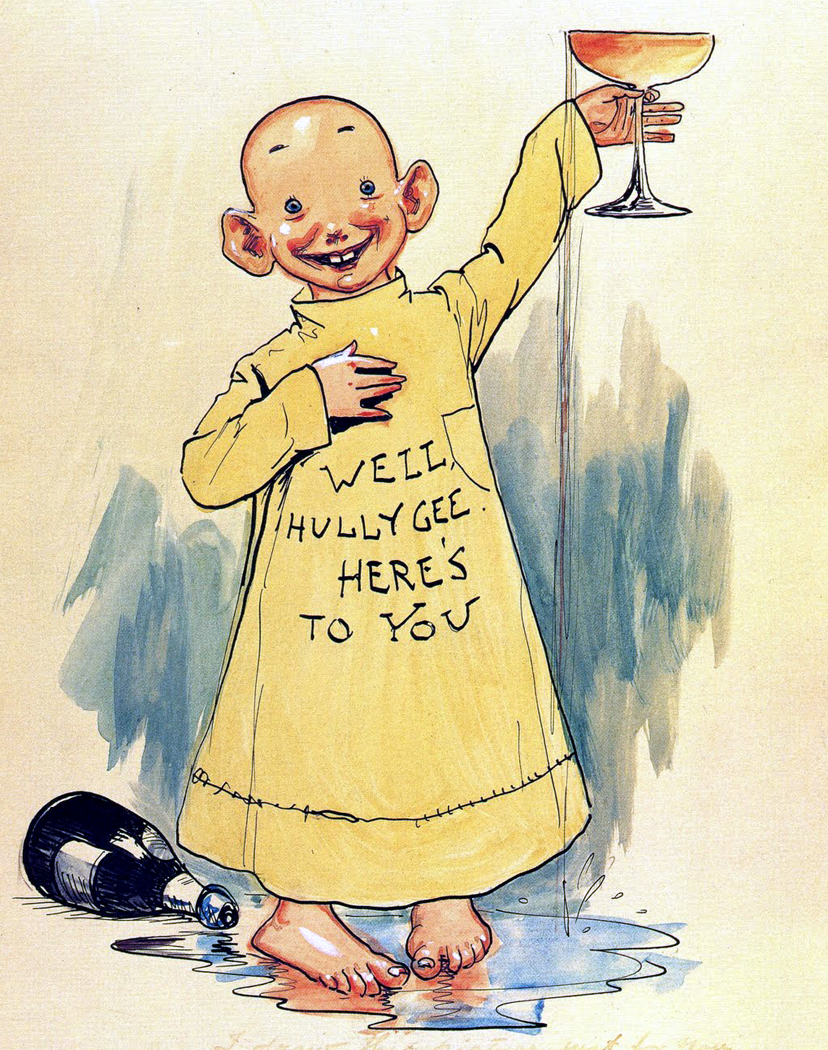
Last night out in cyberspace I came across video of the 1995 Annex Theatre production of The Yellow Kid. Seeing it again… an amazing production–so ambitious in scope for a Seattle fringe theatre company– has me revisiting what is important in my life and how I respect or disrespect my own art.
In a September 21, 1995 Seattle Times interview, Brian Faker told Misha Berson:
“The thrust of our play is the decisions an artist makes – what do you do just for the bucks, and what do you do for your heart’s inspiration? In the end Outcault actually murders the Kid, symbolically destroying something in himself.”
Low-budget production
The struggle to earn a living while maintaining one’s artistic integrity is one that Faker, 35, a versatile stage actor with credits in many Seattle theaters, knows intimately. Currently living on unemployment benefits, he scrambled together $1,100 to finance this shoestring fringe production.
“We’re doing `Miss Saigon’ at the Annex,” he laughs. “We’ve got 27 actors, a cat, a goat, two dogs, 200 slide projections, film, rolling scenery. It’s just a monster.
“We’re funding this completely out of pocket – and out of favors. My wife (actress Peggy Poage) is probably our biggest contributor. And a lot of other people just decided to go insane with me on this.”
I was in that production and The Husband was in the booth as stage manager. We began dating during the run. A framed poster from the production hangs in our living room, next to photos of My Kid as a toddler in long yellow shirt.
That is the question of the current project I’m involved in. A call went put out for actors with children to work on a piece for the Six Figures Theatre Artists of Tomorrow Festival. I signed on with My Kid, even though she has no intention of performing. The director is pregnant and has a 2-year-old. One actress has a 3-year-old and another has a 10-month-old. Everyone at rehearsal, but the musician, has a kid that they bring to rehearsal but the musician. My kid is the oldest, the only one who even knows what is going on. But, she comes willingly because she likes playing with the babies. Sometimes it’s complete chaos more like a playgroup or toddler music class with the 3-year-old running and screaming and the 2-year-old refusing to relinquish the musician’s song sheet and the baby moving around the room followed by her mother who is pinching off bits of banana and placing the food in the baby’s mouth like a mother bird. My Kid adds her own notes to the cacophony.
Do you want to be an actress, My Kid?
Barely perceptible nod, “no”.
Do you want to be a dancer, My Kid?
Barely perceptible nod, “no”.
Do you want to be an engineer?
Big smile. Big nod to the affirmative.
Last year My Kid joined her elementary school’s robotics team. They spent the year trying to solve alternative energy challenges using Lego’s.
As a child, I too learned about renewable sources of alternative energy –off the back of a truck:
This week, My Kid came home with a letter from her First LEGO League coach about their mission for 2008
The Project:
1.)Research how climate affects your own community. Identify a climate problem in your area, analyze climate data about the problem, and discover what your community is doing about it. Find another community somewhere in the world with the same issue and identify any solutions they are working on. Discuss the various ways climate impacts your community and your lives. Look at climate data available for your area as it relates to your climate problem. Consider talking with experts who work with or in climate everyday, like climatologists, farmers, foresters, and community leaders. Then find another community in a different geographical area that is experiencing a similar problem.
2.)Create an innovative solution based on the information you gathered that could be used on a local or even global level to solve this climate problem or improve on an existing solution. Consider all the potential solutions to your climate problem and how great an impact you can have. Talk with experts to see what solutions are already being developed or used. Build your climate connections by creating an innovative solution to your chosen climate problem that could be applied in both communities and could be adopted by even more communities who face a similar issue.
3.) Once you have researched and developed your solution, get out there and share it! Take what you’ve learned to build awareness of the problem and promote your solution. Show your research and solution and use this project to see just how great an impact you can have on your community and your world!
That’s a lot to ask of elementary school students. And yet it is the same thing they asked of us when I was in grade school. Our teachers, and TV, told us that the adults who built the factories with smokestacks that filled the air with acid rain causing pollution, and poured the sludge into the rivers that killed the fish, and the birds that ate the fish, were ignorant. They didn’t know that would happen.
So Woodsy Owl told us kids that the clean up was our job!
This year My Kid’s multidisciplinary curriculum is based around the theme of community, both local and global. The children are taught the same thing they learned watching High School Musical; “We’re all in this together”. In the spring there will be a large art project utilizing recycled materials. The students will learn how to police the glass, paper & plastic sorting skills and light bulb choices of their parents. They will sell us canvas shopping bags covered with pictures drawn in Sharpie marker of crying trees and slogans reminding us to reduce, reuse and recycle!
“Next year I am going to save the world.” My Kid said in happy anticipation, at the school festival last spring, believing this to be what one does in the third grade.
As children, we were told that the world was ours to save.
Years later my kid is being told the SAME THING because WE FAILED!
My generation was raised in the 1970’s during the Energy Crisis, in cold houses with adults fretting about the length of our showers and the high price of oil. “Could gasoline ever really go over $1 a gallon?” was one summer’s unending conversation. Yet, many of us grew up to buy SUV’s to chauffer our own kids from mall to soccer field to McMansion in suburban housing developments without any sidewalks, miles from the nearest store.
Renewable energy missionaries were out in force when I was a kid in the ’70’s:
I rode my bike to their revival meetings. I wanted to be an actress, but there wasn’t much live theater where I lived. Desperate for role models. I fell for The New Western Energy Show hook, line and sinker. It was like meeting the real life version of my Sunshine Family dolls, made by Mattel, Inc. (NYSE: MAT)
I even had the Sunshine Family Van. I considered it one of my best Christmas presents ever! It was converted truck, with a wooden shack on top, from which the dolls apparently sold handmade pottery and leather goods at craft fairs. So you see this all seemed to me, at the time, to be an acceptable, viable, creative, even mainstream, future way of life.
But, by the time I was graduating from high school and college in the ’80’s, communal living hippie-types had turned into selfish Yuppies, and those who hadn’t were scorned. I polished my resume and wore suits in order to project a professional image. Wall Street said “Greed is good”.
Now, hipsters are getting crafty with recycled textiles, making clothes and bags to sell at flea markets and festivals, magazines and newspapers offer frugal living tips, and billboards advertise energy saving appliances.
Yesterday I received an e-mail, forwarded to me by Kendall Cornell. The Women’s Theatre project was papering their Off-Broadway house for a play about a clown. So I went. It was a much nicer theater than the ones I usually get to play. The stage was large and the grid was jam-packed with lighting instruments. Most of the primary people involved in the production listed a Yale degree in their bios. That theatre seemed out of my reach and yet the play was obviously written by someone who is not very old and reminded me of shows we produced at Annex Theatre in Seattle where, incidentally, quite a few company members had gone to or would go on to Yale.
After the play, “Aliens with Extraordinary Skills” by Saviana Stanescu (MFA, NYU); directed by Tea Alagic (MFA, Yale); featuring Natalia Payne (BA, Yale); Set Design by Kris Stone (MFA, Yale); Costumes by Jennifer Moeller (MFA, Yale); Lighting Design by Gina Scherr (MFA, Yale); Music and Sound design by Sarah Pickett (MFA, Yale), I walked alone to the Times Square subway station.
My heart raced, as I looked at the marquees and the after theatre crowd brushed by me with their playbills in their hands. I was remembering my very first trip to New York. I took the train from Washington D. C. (where I had an internship in the Women’s Division of the Democratic National Committee when Geraldine Ferrarro was running for Vice President on the Democratic ticket with Walter Mondale) to visit Kathy McNenny, who I knew from home. She was attending Julliard and living in a room, not much bigger than her mattress, in a very scary building in Hell’s Kitchen across the street from Studio 54. I was afraid I would be raped every time I got on the elevator.
I saw 6 shows in about 48 hours. I went with Kathy and her boyfriend to see a play at The Irish Rep because a friend of theirs was in it. There was a lot of real dirt on the stage. I saw ” A Chorus Line” because I had always wanted to see it. I had received the album as a birthday present in grade school and had listened to, memorized, and performed, for my drama class, a deeply felt rendition of “Nothing” (just like all the other high school theater geeks my age). After “A Chorus Line” I went directly to another theatre to see Whoopi Goldberg’s late night performance, because Kathy told me that was the must see show everyone was talking about. I was blown away proclaiming that we would soon hear of her in Montana. “The Color Purple” was in movie theaters the next year. As soon as I woke up I went directly to the TKTS booth in Times Square to see what I could see. I wanted to see “Sunday in the Park with George” because I wanted to sing like Bernadette Peters, even though my voice teacher was always telling me not to (apparently I had a lovely voice of my own or some such drivel…) But, there were no TKTS tickets for “Sunday in the Park with George” so I got a ticket to “Forbidden Broadway” and went and sat on the ground outside the box office of the theatre where “Sunday in the Park with George” was playing and waited with a few other people until curtain time to see if there were any returns. I blushed with pride when someone in the ticket line, told me I looked like a real New Yorker and not at all like a tourist, sitting there on the ground and scribbling in a notebook, in my dark oversized coat full of pockets. The woman in the ticket booth told me she had some obstructed view seats but they weren’t worth it because they were way off to the side and you couldn’t see the amazing set come and go. So I waited until almost 8 o’clock and then ran down the street to use my ticket to “Forbidden Broadway” which I didn’t find funny since I wasn’t familiar with most of the shows and certainly none of the personalities being parodied. I went to Greenwich Village to see “The Fantastiks” because I adored that musical, having seen a such sweet chamber production of it in Missoula, accompanied by two grand pianos (or one grand piano and a harp–anyway it had been beautiful) and ever after wanted to be a good enough soprano to sing the role of “Luisa”. I believe I also saw “Le Cage Aux Folles” on Broadway that weekend. (“I Am What I Am” is a favorite song and I harbor a fondness for drag queens. “Pricilla Queen of the Desert” is one of my favorite films.) Between the shows I walked around and ate bagels and slices of pizza. My first bagel in New York was schmeared with an enormous amount of cream cheese and the man behind the counter said something to me that made me think he gave me extra for good luck on my first day in New York. All the money I had went for theatre tickets. No restaurant meals, no drinks. I didn’t even know at that point in my life that I ought to buy food or wine or a gift for my host who I actually never saw after joining her for the one play. She was so busy with classes and rehearsals. She told me when she first came to New York she tried to live in Queens (where the rent was lower and the rooms were bigger) but it was just too far away.
If Queens was too far away from Broadway, how very much more difficult must it be to get there from Missoula, Montana. Although both Kathy McNenny and JK Simmons succeeded. They represented the only two ways I knew of to get to New York. JK Simmons didn’t go to New York until after he had his Equity Card. I knew this because his brother David was a friend of mine and his father was my freshman advisor at the University of Montana. I also knew that his skills included the ability conduct an entire orchestra! (He was very nice to me and invited me out for a drinks with the cast after I sent a note backstage, via an usher, letting him know someone from Missoula was in the audience, when I saw the touring production of the short-lived broadway musical “Doonesbury” in which he played a small part and understudied most of the others. –It was during same fall term of my political internship as that first trip to New York.) The other way to get to New York, as I understood it was to get into a school, scholarship necessary. Kathy McNenny was able to do this after first attending the University of Montana. I remember other drama majors, eager to get on with their lives after college, talking about Kathy’s decision to go to Julliard where she would have to pay for another bachelors degree, instead of going to the Globe in San Diego which offered her a full-ride, an MFA and an Equity Card. But it wasn’t in New York.
Kathy knew what she was doing and I was not in the same league. In high school she was a competitive swimmer with a near perfect GPA, president of the Thespian Society, in the select show choir and involved in many other organizations that involved having her photo in the high school year book. She taught swimming lessons and visited schools as Captain Power for the local utility, possibly the only paying costumed character gig in the entire region. When she was a senior and I was a junior, she played the title role in our high school production of “The Prime of Miss Jean Brodie”. I played one of her pupils who grew from child to adult under her tutelage. I was the only actress who did not have to bind for the first scene and had to stuff my bra for the last scene. That pretty much says it all.